Mastering is a vital part of the music-making process. At a recent dCS event in New York, mastering engineer Alan Silverman discussed how it can impact our perception of a recording and the emotions we feel when listening…
Mastering engineers play a crucial role in music production. They are the last step in the album-making process – the people responsible for applying the final sonic touches to make sure each track sounds just right and each album feels like a cohesive whole. Often, they deal in subtle changes: adjusting levels and frequencies at specific moments throughout a song, defining the time between tracks, deciding how and when each track should fade in and out. Yet the impact of these changes can be immediate and significant. The decisions undertaken in the mastering studio can change the mood of a recording, what we notice within it, and what we feel when listening.
It is, in many respects, a technical job, preparing files for various formats and streaming services, and ensuring all the relevant data is encoded within. But it’s also an art form: a role that demands creativity, intuition and of course, an ear for detail…
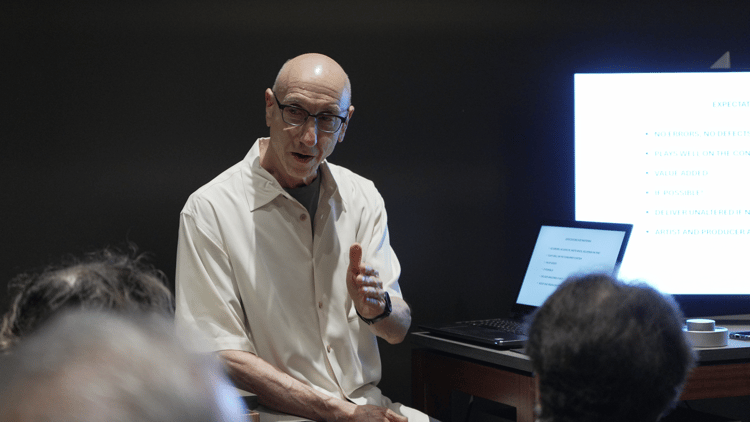
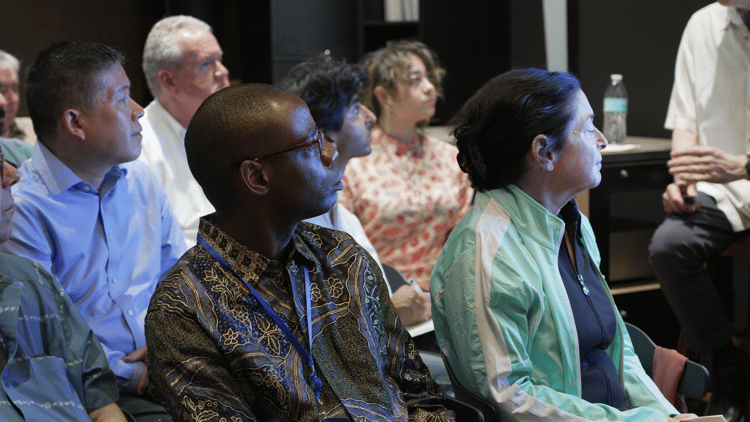
Earlier this summer, mastering engineer Alan Silverman offered a fascinating insight into his work and process at a one-night event hosted by dCS and Innovative Audio. Speaking at Innovative’s showroom in New York City, Alan discussed how mastering has evolved since the early days of cutting vinyl records, what he strives for when working on a mix, and some of the techniques that he has employed to help bring out an artist’s intention. In a 90-minute presentation, he compared examples of mixes pre- and post-mastering to demonstrate how even subtle adjustments can have a notable impact on sound.
Alan Silverman discussing his process at Innovative's New York showroom
Alan is a renowned engineer who has mastered over 10,000 tracks. He started out as a technician at New York’s famous Electric Lady studios back in the 1980s and founded his own independent mastering house in the 1990s. He has since worked on over 100 GRAMMY-winning and nominated recordings, including albums from Judy Collins, Keith Richards, Rufus Wainwright, Willie Nelson and Norah Jones.
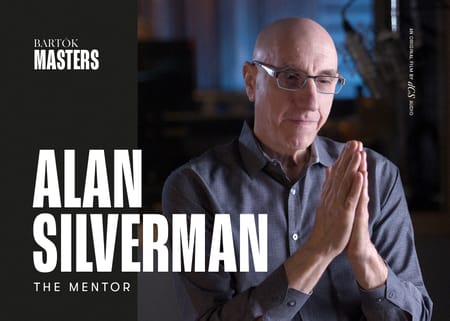
Alan has used dCS components in his studio listening setup for several years and was recently featured in our Bartók Masters film series, which showcases music professionals who use dCS Bartók in their workflow.
Below, we’ve rounded up some highlights from his presentation at Innovative NYC – delivered with fellow engineer and composer Sharon Hurvitz, who joined Alan’s mastering studio Aerial Sound in 2024.
Technical Beginnings
Alan began with a brief overview of the origins of music mastering. As he explained, a ‘master disc’ is one with no errors or defects that can be reproduced any number of times. In the early days of sound reproduction, when music was released on vinyl, mastering was a physical process that came with a lot of challenges. Engineers had to physically get music on to a disc using specialist equipment such as tube limiters and processors, and their main objective was to make sure a record would play from start to finish – a task that might sound simple on paper, but was often anything but.
“For one thing, the surface of the disc [often] had a lot of noise, which meant that the quieter portions of the music might get lost and the noise might be audible,” he explained. “The disc only had a certain amount of capacity for loudness, so the louder portions of the music might not be able to be reproduced without overloading the disc. There are certain aspects of music itself, bass frequencies or phase, that would cause the record not to play at all – the needle would literally lift out of the groove – so the fundamental job of the disc cutting master engineer was just to make sure the damn song would play. It wasn't any more glamorous than that.”
A Changing Role
Now, a mastering engineer tends to spend more time dealing with digital files rather than physical discs. There are a multitude of formats to consider, including vinyl, CD and digital streaming, and the work involved in preparing music for release has expanded considerably as a result.
“Our specs have gotten a lot more complicated,” Alan explained. “We have all of these formats now to prepare for, we have a lot of metadata to include on our masters, which is things like composers, orchestrators, producers, musicians and so forth, and we have codes to encode which indicate who owns these tracks, and who gets paid for them, so there's a lot more involved.”
The nature of mastering has also evolved, from a predominantly technical role to one that can be equal parts creative and technical – a shift that Alan puts down to the work of two pioneering figures, Robert Ludwig and Doug Sax, in the 1960s.
“These two cutting engineers were doing something different. Records that they cut jumped out of the speakers, and not only that, [they] just sounded so good…. This created the notion that a mastering engineer could actually add value to a project,” Alan added.
“
When we have balance, you could say that things are more powerful…. There is more room for detail and clarity
”
- Alan Silverman
Bringing Balance
Sharing a selection of recent projects, Alan went on to show how mastering can add value and elevate a recording, sharing some of the techniques that he has employed to help bring out an artist’s intention, or heighten a recording’s overall impact. Starting with ‘In a Heartache’, a track from Todd Tilghman, he and Sharon discussed how their work can help bring a greater sense of balance to a mix.
‘In a Heartache’ is the first single from Tilghman, a Nashville pastor who won season 18 of The Voice USA. Whilst Alan and Sharon were impressed with the original mix, they also felt upon close inspection that the bass and vocals were competing for attention at points. They decided to reduce the lower frequencies in the recording, effectively bringing down the volume of the bass by around 1dB (an incremental change, particularly compared to the kind of volume adjustments that might be made during the mixing phase).
As audience members noted when listening to both versions one after another, this change allowed Tilghman’s vocals to take centre stage: “Now that the bass isn't competing for my attention, I'm really with Todd. I can hear what he's saying. His emotion is coming through,” explained Sharon. “Not just that, but I'm hearing the call and response of the guitars, and I'm starting to notice a little bit of the keyboard.”
This also brought greater balance to the song’s chorus: “The intricate rhythms of both the bass, the vocal, and all the other instruments are working together in a complex way, rather than us just listening to the static rhythm of only the bass. There's also more definition in the guitarist,” explained Sharon. With this seemingly subtle change, listeners were able to hear the various elements of the track more clearly, with different instruments and sounds all working harmoniously, as the artist intended.
“When we have balance, you could say that things are more powerful. There is a smoother transfer of energy. There is more room for detail and clarity,” explained Alan.
Heroing Vocals
Next, playing ‘Oxala’ – a track from Portuguese singer-songwriter MARO – Alan highlighted how he always looks to bring vocals to the fore in a recording. “What we try to do is just bring that voice forward in the most human way to strengthen that [emotional] connection,” he said. This can involve various techniques – in the case of Oxala, he said he received “a beautiful mix”, but was keen to explore how he could add further value, so set about experimenting with some subtle changes to further hero MARO’s voice. He decided to add a slight increase in lower frequencies to bring some extra warmth to vocals, then boosted higher frequencies to increase the sense of spaciousness, before adjusting the middle frequencies to bring out the sound of the guitars.
“Now I'm becoming aware of something in her expression, an additional emotional component,” he said, comparing the updated version to the original mix.
As Alan explained, this process of adjustment often involves several rounds of testing and listening back – and it can produce some unexpected results. In the case of ‘Oaxala’, adjusting levels resulted in some sibilance and fractives becoming audible [both are common effects that can occur in recordings when someone is singing into a microphone]. These were addressed with the help of specialist tools, allowing the sound of the vocals to take centre stage.
“
When mastering is successful, something surprising and very satisfying happens
”
- Alan Silverman
Reflecting an artist’s intention
In a final musical example, Alan showed how subtle tweaks can help to strengthen the link between the sound of a recording and the emotion or mood that an artist is keen to express – building on the work of mix and recording engineers.
‘Standing on the Stairs’ is a track by Anjani Thomas, a singer, songwriter and pianist who worked closely with Leonard Cohen. Alan was responsible for mastering the track – hearing it for the first time, he was struck by the song’s lyrics, and was keen to explore how he could emphasise the sense of despair that comes through in Anjani’s songwriting.
As a first step, he felt that emphasising the lower register of Anjani’s voice could help to bring out a feeling of angst, as our voices tend to be lower when expressing negative emotions versus excitement or happiness. He also experimented with introducing some subtle compression to bring some additional warmth and richness to the sound, before adjusting bass levels and ensuring the track was free of unwanted effects such as sibilance.
As Alan noted, it’s impossible to predict the impact of changes but in this case the effects were profound. His subtle shifts and tweaks brought an almost thunderous quality to the recording in places, helping to underscore a sense of fear and unease – whilst other refinements helped to heighten the impact of Anjani’s vocal performance.
“It’s not just the voice, it’s everything,” he told the audience. “I feel [Anjani] and the instruments have a different perspective … now, it all seems to support her and the way she's singing, what she's singing about, it has this kind of mysterious, dreamlike-quality about it.”
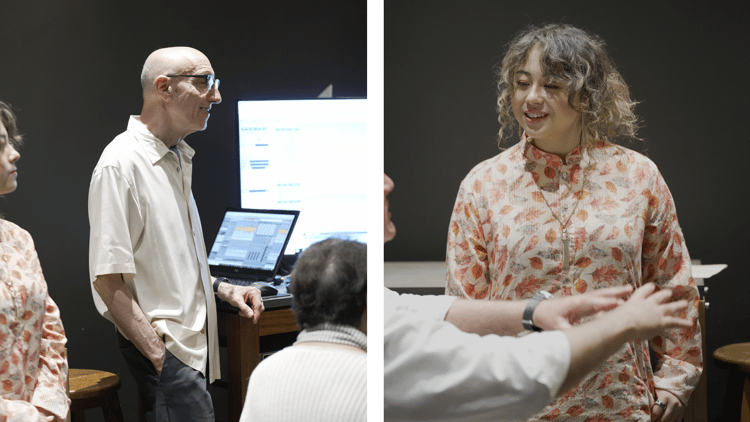
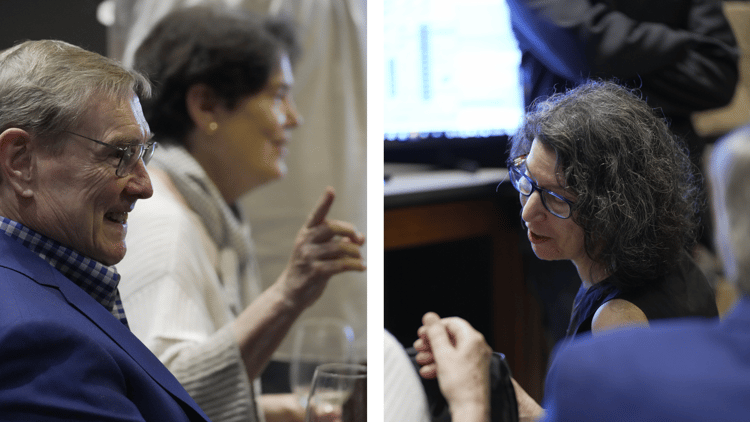
Guests listening to tracks from MARO, Todd Tilghman and Anjani
Forwards, never back...
Mastering can be a tricky discipline to define – as Alan points out, mastering engineers are working with recordings that are ostensibly finished. They have no access to individual tracks within a mix, and have no influence on how something is recorded, composed or mixed [unless involved from the outset of a project]. Yet somehow, through their process of listening, evaluating, and making subtle adjustments here and there, they can help elevate and amplify a recording’s power – in some cases changing what we notice when listening or even what we feel as a result. Referencing a description of mastering sent to him by a client, he described it as a kind of “alchemy”: a process of careful listening and shaping, enabled by technology but ultimately concerned with bringing out the beauty and emotion in a piece of music.
“When mastering is successful, something surprising and very satisfying happens,” he said. “The artist's performance comes through with greater power, in a way … and the music just feels better,” he adds.
We use cookies to enhance your browsing experience, serve
personalised ads or content, and analyze our traffic. By
clicking "Accept All", you consent to our use of cookies.
Cookie Policy
Customise Consent Preferences
We use cookies to help you navigate efficiently and perform
certain functions. You will find detailed information about all
cookies under each consent category below.
Always Active
Necessary cookies are required to enable the basic features
of this site, such as providing secure log-in or adjusting
your consent preferences.
Cookiedcs_consent
Duration1 year
DescriptionStores your cookie consent choices for this site.
Analytical cookies are used to understand how visitors
interact with the website. These cookies help provide
information on metrics such as the number of visitors,
bounce rate, and traffic source.
Cookies_ga, _ga_*
Duration2 years
DescriptionSet by Google Analytics to distinguish visitors and record how the site is used.