Our latest pick of classical music – curated by journalist Charlotte Gardner – includes a must-listen interpretation of Elgar and Dvořak Cello Concertos from Alban Gerhardt and a new release from mandolinist and lutenist Alon Sariel
Welcome to June's Classical Choices!
This month’s playlist opens with a taster of Hyperion’s beautiful new box set (also streamable) celebrating 25 years since the foundation of The London Haydn Quartet – Haydn: The Complete String Quartets. Recorded between 2007 and 2023, these performances combine historically-informed performance practice on period instruments with performing editions published during Haydn’s own lifetime. It’s a cycle you could get happily lost in for many, many hours, and the flavour I’ve given you here is the presto Finale from Haydn’s String Quartet in E flat major, Op.64 No. 6.
Onwards, and the new releases begin with a new pairing of the Elgar and Dvořak cello concertos from Alban Gerhardt; then comes the final instalment of mandolinist and lutenist Alon Sariel’s enterprising ‘Plucked Bach’ series; and finally, a major new Martinů symphony cycle from Jakub Hrůša and the Bamberg Symphony Orchestra.
One more thing. This month has also seen the launch of a brand new podcast series, presented by me for Gramophone in partnership with dCS Audio – The Gramophone Listening Room. Each episode I’m joined by two younger-generation artists who each share – discussing in suitably nerdy detail – two recordings that have shaped their lives.
We’re all very excited about it. Hopefully you will be too. Find out more, along with the links to the actual episodes, here.
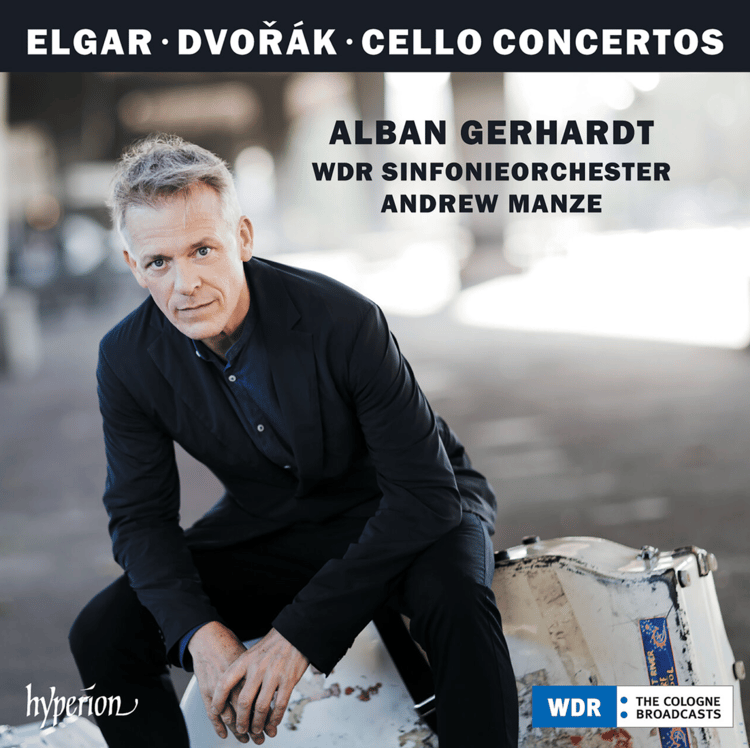
Elgar and Dvořak: Cello Concertos
Alban Gerhardt, WDR Sinfonieorchester/Manze
Hyperion
Elgar’s and Dvořak’s cello concertos, completed respectively in 1919 and 1894, stand out not simply for being the twin jewels in the cello’s Romantic concerto crown, but also for existing in the consciousnesses of many music-lovers through two specific recorded interpretations from arguably the 20th century’s two best-loved cellists: Jacqueline du Pré for the Elgar, and Mstislav Rostropovich for the Dvořak. There’s a sense to which this is rightly so, too, those two interpretations are so thrillingly full of human emotion. Yet listen along to them while following the scores, and you’re in for a bit of a shock, both performances jettison so many of Elgar’s and Dvořak’s own directions in the score.
Whether that ultimately matters, when the results tug at the heartstrings as they do, is up for debate; I’ll admit to my personal opinion on this tending to change with the wind. Arguably more of a problem is how their deviations have slid by osmosis into subsequent interpretations by other cellists. Either way, you couldn’t find a more eloquent argument for sticking to what the composers asked for than Alban Gerhardt’s pairing of both concertos with Andrew Manze and the WDR Sinfonieorchester.
As I’ve hinted, you’ll hear from Gerhardt and Manze plenty of expressive detail, in the articulation and dynamics, that doesn’t make it quite so faithfully onto every recording. However Gerhardt’s ‘Just follow the score’ approach is most keenly felt in the extent to which both concertos move along with a natural and altogether more fluid, faster tempo than we’ve become accustomed to hearing in these works. ‘There is a widely held belief’ says Gerhardt in his introductory note, ‘that the slower one plays, the more profound the result will be… In my experience, music can lose as much as it gains when it lingers too long’.
To rather crassly illustrate that with some timings, Gerhardt and Manze’s Elgar first movement is a minute shorter than Du Pré and Barbirolli and almost 2 minutes shorter than her account with Barenboim, while their Dvořak is almost 2 minutes faster than Rostropovich and Karajan. Neither of these new performances, though, suffers from lack of emotion; in fact, quite the opposite, it’s a case of intensity married with a newly free-flying lyricism that’s had me hearing new things. How natural and sweetly songlike the Elgar’s Adagio sounds, for instance; and how lyrically comfortable in its boots is the three-time of Dvořak’s central movement, and how pastoral its woodwind; or listen from around 10 minutes into the Dvořak first movement to hear Gerhardt’s cello riding – exhileratingly – the gradually accelerating orchestral wave, before flinging itself wildly into its downwards descent.
All in all, this is a must-listen, and for the playlist I’ve given you the Dvořak.
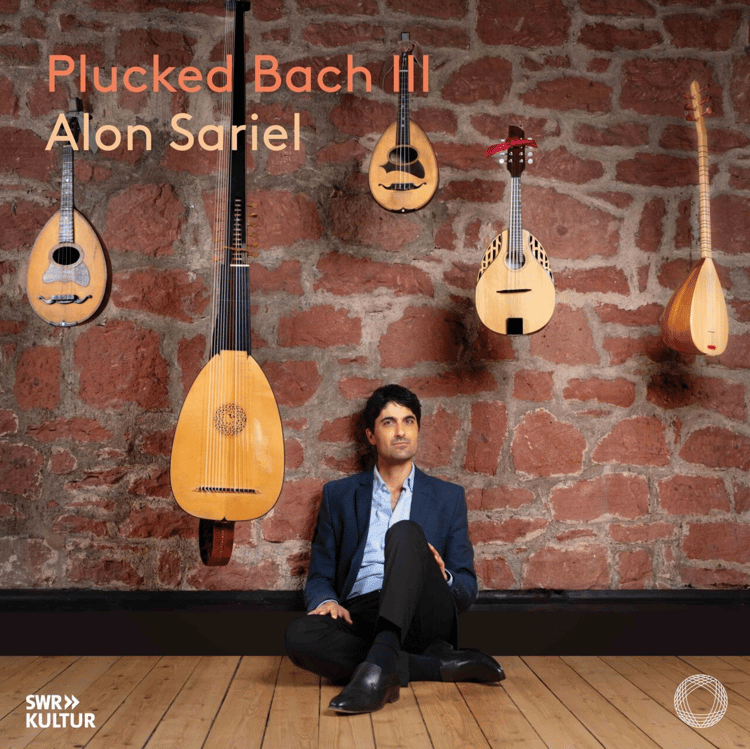
Plucked Bach III
Alon Sariel
Pentatone
In 2022, mandolinist and lutenist Alon Sariel made his debut on Pentatone with ‘Plucked Bach’, exploring Bach’s cello suites on different mandolins, lutes, baroque guitar and oud. He then picked up the Bach thread in 2024, turning his arranging powers that time to various violin and keyboard works, with Ysaÿe’s ‘Obsession’ from Bach-inspired Solo Violin Sonata No. 2 thrown in for good measure. Now Bach III is this striking series’s final chapter, and it’s a fittingly climactic programme: violin, keyboard and cello works by Bach – complemented by works by his older contemporaries Nicola Matteis and Johann Paul von Westhoff – which he has transplanted onto archlute, tuscan mandola, tuscan mandolin, mandolin and bağlama.
As with the cycle’s previous instalments, this album’s overall characteristic is the intimate, introvert quality of Sariel’s interpretations; the pensively leisurely tempos; always the experience of familiar music being translated into a panoply of new colours and textures so as to sound completely transformed. His curtain raiser sets this scene perfectly: the Adagio from Bach’s Sonata No. 3 in C major for solo violin, quietly calm and elegant on archlute and making full use of this instrument’s bass-register sonorities. Similarly, the famous C major prelude from Book 1 of the Well-Tempered Clavier is exquisitely different in the soft high treble tones of a tuscan mandolin, while the Solo Cello Suite in C major is given to tuscan mandola – an octave lower and more intimately velvety-toned than a standard mandolin.
The soft-fluttering bariolage of Von Westhoff’s ‘Imitatione delle campane’, from his Violin Sonata No. 3 in D major, comes with a dazzling new, shimmering brightness via its transferal to the mandolin. It’s equally the mandolin onto which Sariel has transcribed Bach’s solo violin Chaconne in D minor; and here there’s an interesting comparison to be made with mandolinist Chris Thile’s recent transcription of the Chaconne, because while Thile has gone close-miked and with the addition of a soft percussion beat and folky inflections, Sariel takes a more obviously classical approach – spaciously poetic, rubato’d and embellished, the capturing less close and with greater surrounding resonance; and while Thile did eventually win me over, Sariel had me from first bar.
It’s the Musette in D major from Anna Magdalena Bach’s notebook which gets the bağlama treatment, and it sounds throughly at home in its newly exotic Turkish folk music twang; especially when the tempo and rhythm pick up. One further nice touch is how Sariel has split his programme into various clusters of works sharing keys.
On the playlist you’ll find the album’s final three works: von Westhoff’s ‘Imitatione delle campane’, Bach’s D minor Chaconne and his Sarabande from the Solo Cello Suite No.4 in E flat major.
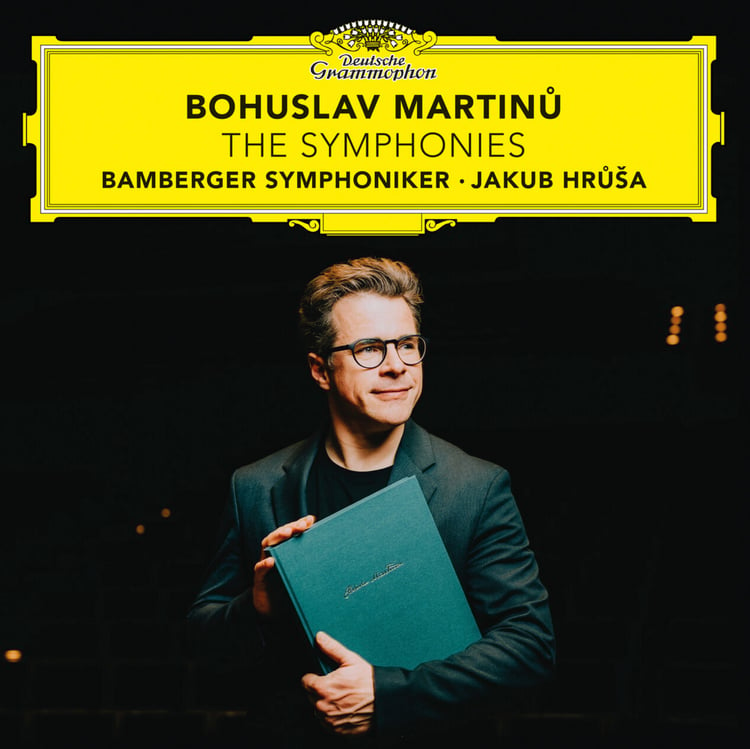
Martinů: The Symphonies
Bamberg Symphony Orchestra/Jakub Hrůša
The six symphonies of Czech composer Bohuslav Martinů, composed between 1942 and 1953 while he was in exile in the USA, may not be unrecorded but they’re certainly not over-recorded. It is also some years since a significant cycle dropped – and this from the Bamburg Symphony Orchestra and its Chief Conductor Jakub Hrůša is certainly one of those, Hrůša being one of the world’s most exciting interpreters of the Czech repertoire, and this also being Deutsche Grammophon’s first-ever substantial Martinů project. The recording process itself was also a bit special. The symphonies were all first performed and recorded live, in order, in the Bamberg Symphony’s home hall, the Joseph-Keilberth-Saal; but following this were extra recording sessions that went beyond standard patching sessions, to ensure the detail was properly captured; and with the same producer and engineer across the entire cycle. So this is hybrid-live, if you like, with detail and continuity the watch-words.
The results justify all the care that was taken. This is shape-shifting music: one moment dark and glowering, and the next brightly luminous; tonality constantly slipping between major, minor and scrunchy; tempo and orchestration similarly a fast-changing feast of colours and densities, and with Martinů’s trademark syncopations everywhere – and this has all been perfectly captured by Hrůša and his team. Martinů’s tricky rhythmic language – one which is simultaneously smartly precise and silkily, restlessly resisting solidity – has been realised with a fluidly flowing, pulsing momentum, Hrůša getting a beautifully subtly balance between rhythmic edge and gentle rubato; listen over the Sixth Symphony’s Poco allegro second movement, whose music appears to be playing itself, there’s such a natural organicism to it all. Martinů’s scoring detail is also all there to be enjoyed, from the piano being just present enough but not soloistically so, to the care taken over the more soloistic-feeling pops of colour, such as the woody, sinewy-toned cello in No 1’s first movement.
Emotionally, the darkness in these works is there, but so is Martinů’s overriding energy and optimism; you feel that these symphonies are more a love letter to the folk music of his homeland, perhaps with some American modernism in the mix, than an expression of the wartime and authoritarian darkness he had escaped. The orchestral sound itself meanwhile has a gorgeous, polished sheen, with both dark weight and diaphanous delicacy, sharp edged punch and lyricism; and with the Joseph-Keilberth-Saal acoustic the final cherry on the cake, affording both precision and a warmly rounded sense of space. Climaxes pack a punch.
For the playlist, I’ve given you the Sixth Symphony.