Welcome to our latest Classical Choices, which opens with a 1959 recording of one of the great masters, at his technical best in a wonderful interpretation, captured with fidelity and finesse: Isaac Stern with Eugene Ormandy and the Philadelphia Orchestra in the first movement of Tchaikovsky’s Violin Concerto.
From there it’s on to our new releases, the first of which will be a discovery to many: the first studio recording of trumpeter, band leader, conductor and composer Wynton Marsalis’s Blues Symphony of 2009, from the Detroit Symphony Orchestra under Jader Bignamini. Next, we have an unusual programme of Liszt piano works from Leif Ove Andsnes and to close, a clever pairing of violin concertos from violinist Lea Birringer with the Staatorchester Rheinische Philharmonie under Benjamin Shwartz. Enjoy!
Marsalis: Blues Symphony
Detroit Symphony Orchestra/Bignamini
Pentatone
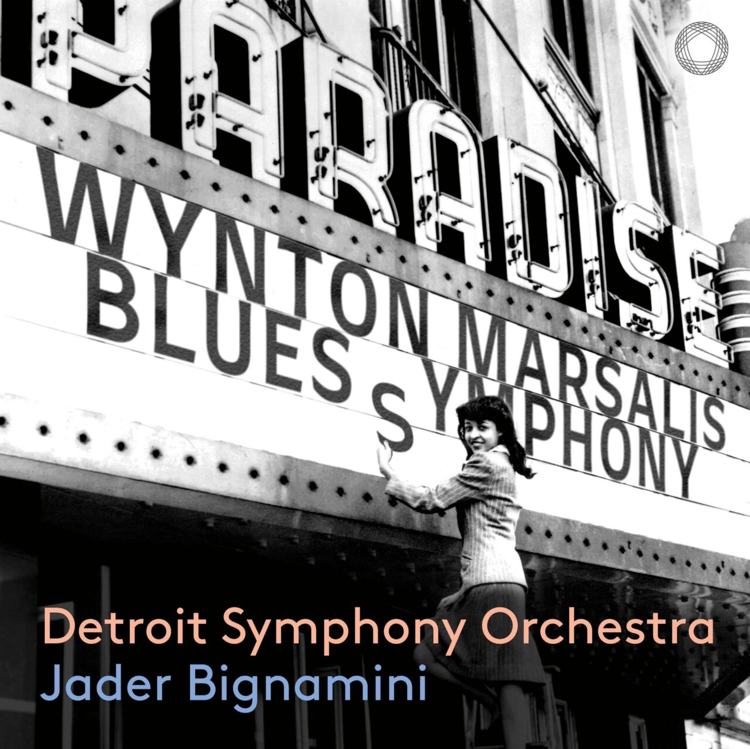
The cover art for Jader Bignamini and the Detroit Symphony Orchestra’s recording of Wynton Marsalis’s Blues Symphony (completed in 2009) features a striking image of Detroit’s Paradise Theatre: a venue that has hosted various jazz and classical musicians over its 100-year history. In the 1940s, Paradise was the place to see jazz greats from Duke Ellington to Billie Holiday, Louis Armstrong and Dizzy Gillespie. It closed in 1951, but was later renovated in a major project, and is now the Detroit Symphony’s official home.
With seven movements, amounting to over an hour of music, and a blend of styles from ragtime to habanera, Blues Symphony doesn’t present like a symphony, at least on the surface. Yet it delivers such scope, ambition, and narrative sweep that this feels like a fitting title.
Further pleasures come from the piece’s panoply of textures and masterfully handled contrapuntal complexities – at times, it feels as much a tribute to Bach as it does to jazz. The DSO brings the perfect balance of panache, polish and grit, with deft ‘under-the-skin’ handling from Bignamini. Add suitably polished capturing, and you have a wonderfully exuberant listen. I’ve selected the first two movements, ‘Born in Hope’ and ‘Swimming in Sorrow’ for our playlist.

Liszt: Via Crucis & Solo Piano Works
Leif Ove Andsnes
Sony Classical
The fact that Franz Liszt was a devout Catholic is often overlooked amid the noise and colour of his life. His amorous exploits were rather far from what the Church might have expected of its subjects, and indeed the Roman Catholic authorities prevented him from marrying the love of his life, Carolyne von Sayn-Wittgenstein, refusing permission to annul her previous loveless marriage. Yet in 1865, when Liszt retired from the concert stage, he took minor orders in the Catholic Church.
The sincerity of his faith, along with his continued compulsion towards musical innovation, are out front and centre in his Via Crucis, a piece completed near the end of his life in 1879, but not premiered until 43 years after his death, when it was performed in Budapest on March 29, 1929.
Scored for the unusual forces of mixed choir, soloists and organ – or piano or harmonium – it depicts the Stations of the Cross via a mix of unison songs, Lutheran chorales, Bach-inspired chorales and solo keyboard. At times, the music stretches the boundaries of conventional tonality. Its heartfelt sobriety makes it an entirely different music beast to Liszt’s dazzling virtuoso piano pieces or orchestral tone poems, although some of the piano writing of Station XI feels reminiscent to the famous B Minor Sonata’s resplendent B major theme.
It’s a deeply striking work for pianist Leif Ove Andsnes to have taken on. His sensitive reading makes a thorough case for both the piece itself and for hearing it in its piano version. To this, the Norwegian Soloists’ Choir brings a warm clarity and similar serenely devotional fervour.
Andsnes ends his all-Liszt programme with more warmly prayerful, sensitively voiced and coloured readings of further religion-inspired works for solo piano: the six solo piano Consolations composed between 1844 and 1849, and two movements from the Harmonies poétiques et religieuses. The result is a very beautiful album, not at all of the flavour one generally associates with Liszt. You’ll find the Via Crucis on our playlist.

Sibelius, Szymanowski, Järnefelt
Lea Birringer, Staatorchester Rheinische Philharmonie, Benjamin Shwartz
Rubicon
Geman violinist Lea Birringer has some heavy competition for her recording of Sibelius’s Violin Concerto, and this brightly slender, fierily expressive reading holds its own among them. At times, the Staatorchester Rheinische Philharmonie doesn’t quite have the fathoms-deep smoulder, granite strength and presence that the first movement of the Concerto appears to demand, yet its partnering of Birringer’s poised Adagio di molto feels exactly right.
Still, it’s the partner works that really make this recording. Szymanowski’s Second Violin Concerto is an exceptionally complimentary choice: completed in 1933, nearly 30 years after the Sibelius, it also feels lushly Romantic in its scoring, and draws on folk rhythms and modal harmonies, yet it provides an interesting foil through its more headily sensualist sound world, exotic chromaticisms and distinctive colours such as piano. Birringer and the orchestra have its measure too, leaning wholeheartedly into its generously radiant, excited mood, and with Birringer’s cadenza a perfect marriage of white-glowing poeticism and supple, brilliant technique.
Tucked between those two is a Berceuse (lullaby) written in 1904 by Sibelius’s brother-in-law, Armas Järnefelt, inspired by the sight of his two-year-old daughter sleeping. As with the Sibelius, it’s richly scored, dark-tinged and Romantic, and like the Szymanowski, it has some very special colours, such as when a solo cellist and then the orchestral strings rise up to duet in unison with the solo violin, all bewitchingly shaped by the musicians. It’s the Szymanowski you’ll find on this month’s playlist.