Our latest pick of classical music – curated by journalist Charlotte Gardner – includes a concept album from soprano-conductor Barbara Hannigan and a Hyperion label debut from Amsterdam Piano Trio
Welcome to Classical Choices!
Usually this column is entirely streaming-oriented, but this month’s archive choice will be of particular interest to those readers who also appreciate the vinyl sound. It’s the Rondo-Finale from Mahler’s Symphony No. 5, as recorded quadraphonically on analogue in 1970 by Bernard Haitink and the Amsterdam Concertgebouw for their Mahler cycle on Philips. Now available on Decca, its capturing in the orchestra’s famous Concergeouw was praised in its time for its clarity and balance. Listening to it as it appears on the playlist will illustrate why.
Yet if you happen to own a turntable, you will also want to know that this Mahler 5 is one of this month’s five new releases on the Decca Pure Analogue vinyl series, for which Decca is returning to the original analogue sources of some of its catalogue’s most iconic stereo and quadraphonic recordings, and using 100% pure analogue techniques at the renowned Emil Berliner Studios, they’re being pressed onto 180-gram heavyweight virgin vinyl and sold as limited-edition, hand-numbered deluxe gatefold releases featuring the original artwork and liner notes, archival photography, facsimiles of original recording session sheets, and newly commissioned notes that include insight into the mastering process. As a physical article, they’re just beautiful – to sit down to listen with ones of these weighty, information-packed record sleeves on your lap is all part of the experience.
Most importantly though, the sound is phenomenal. As you would expect, the degree to which you’re hearing the uplift in sound quality varies from record to record, not least because some repertoire and capturing will naturally dance into 3D more palpably than others. I’ve singled out Haitink’s Mahler, re-mixed by Rainer Maillard, because that uplift is so gloriously pronounced; whereas the original Philips engineers would have mixed the original four front and rear channels before cutting down, but ended up with a two-track stereo copy for mastering, Maillard has preserved a pure analogue path throughout by using the original four-channel master tape to make a new ‘live’ stereo mix that’s sent directly to the cutter head. If all this has piqued your interest, then of the first drop this past January I’d urge you to get your hands on Stravinsky’s The Rite of Spring from the Chicago Symphony Orchestra and Sir Georg Solti, which was recorded in two-track stereo at Medinah Temple in 1974, and has now been cut from the master to play at 45rpm, in contrast to the original playing at 33 1/3
Back to the glorious of the modern digital age’s new releases, and my May three for you are Barbara Hannigan and the Gothenburg Symphony Orchestra’s tribute to America 250 for Alpha Classics, an eye-catching pairing of works from the young Amsterdam Piano Trio making its debut on Hyperion, and a French-themed crowd-pleaser from John Wilson and his Sinfonia of London on Chandos.
An American Dream?
Barbara Hannigan
Gothenburg Symphony Orchestra
Alpha Classics
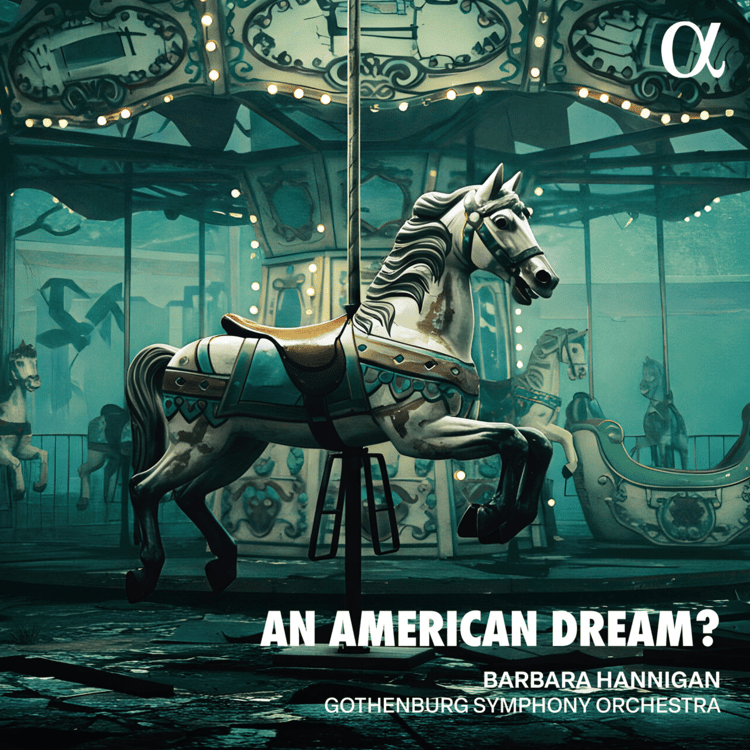
This year’s 250th anniversary of the Declaration of Independence is serving up all sorts of musical delights, and none more so than this darker-tinged exploration of the concept of the ‘American Dream’ from Canadian soprano-conductor Barbara Hannigan and her long-time partners, the Gothenburg Symphony Orchestra. This complexity begins with its cover image: a fairground horse which, for all its prettiness, is welded to a lights-half-out, dilapidated carousel. It continues with the fair-themed, all-American programme: Robert Russell Bennett’s symphonic arrangement of Gershwin’s opera, Porgy and Bess, whose themes of love and hope rub shoulders with those of racism and addiction; Copland’s Dance Symphony, inspired by watching the famous 1925 Dracula film, Nosferatu; ‘The Carousel Waltz’, the overture to Richard Rodgers’ dark broadway musical, Carousel; then finally, Hannigan singing as well as conducting ‘At the Fair’, a symphonic suite of American songs and themes created jointly with composer and arranger Bill Elliott, that partners merriment up with disillusionment.
Hannigan’s interpretations have teased out all the darkness to be found, and with immense style. The languor of Gershwin’s ‘Summertime’ for instance feels unusually tiredness and hopelessness-induced, emphasised by the weary droop to its falling intervals. Yet the album is quite the opposite of a depressing listen. For starters, that’s just not possible with such exuberantly energetic repertoire. And all the more so when from Hannigan and the Gothenburg it’s all sounding so deftly shaped and shaded, vibrantly coloured, rhythmically jaunty, vigorous and precise, and with a swooping Hollywood finesse to the overall performance style (very John Wilson…). Whatever Hannigan may think of the current state of America, these readings are ultimately as loving and celebratory as they are complex; and with ‘At the Fair’ is the grand finale that it should be. The latter’s shape-shifting vocal acrobatics show from Hannigan is also, as it reaches the final climax, given a little extra vibrato swagger by the engineering. In fact one further aspect to be enjoyed is that Hannigan has clearly embraced this album very much as a recording project rather than simply a concert recreation; subtly, to be sure, but you notice it in touches such as the presence afforded to the solo clarinet in the Gershwin – which is the work you’ll find on the playlist.
Schoenberg Verklarte Nacht, Tchaikovsky Piano Trio in A Minor
Amsterdam Piano Trio
Hyperion
Tchaikovsky’s symphonic-length Piano Trio of 1882 and Schoenberg’s 1899 Verklärte Nacht (‘Transfigured Night’) don’t look at first glance like natural bedfellows: lyrical Russian Romanticism on the one hand, and early Second Viennese School on the other.
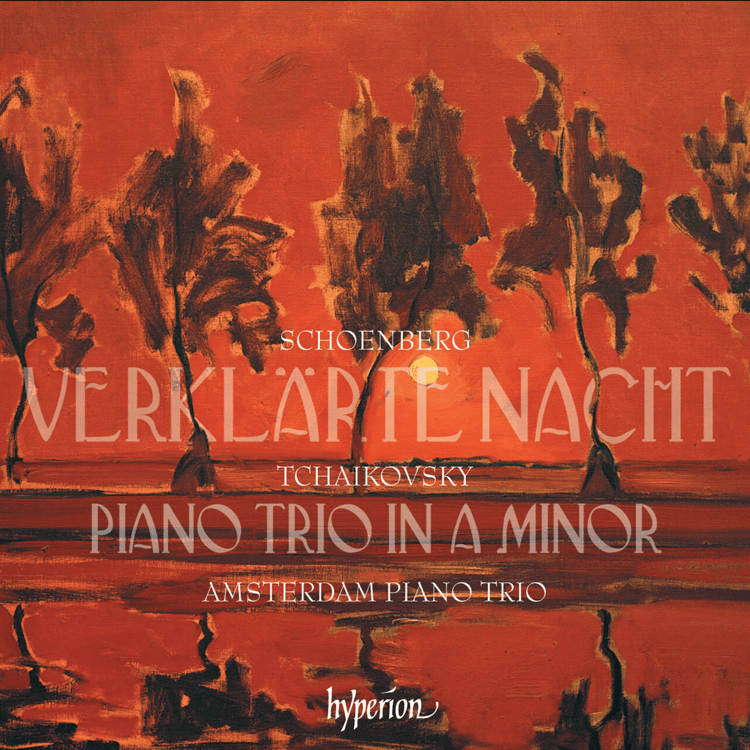
Yet take a closer look and you see what a clever pairing the young Amsterdam Piano Trio has thought up for its debut disc with Hyperion. Both works, for instance, were written as an expression of love: Tchaikovsky towards his recently-deceased pianist and conductor friend, Arthur Rubinstein, and Schoenberg towards his wife-to-be, Mathilde; and those respective passions are potently felt resultant music. Then while Tchaikovsky’s trio moves from quiet melancholy to a full-blown fortissimo lamentation before ultimately subsiding into an exhausted funeral march, a quietly funereal trudge is then how Verklärte Nacht opens – despite its own emotional passage in fact moving from dread to radiant absolution (the work depicts a Richard Dehmel poem in which a woman uses a nighttime walk with her new lover to confess that she’s already carrying another man’s child). Musically meanwhile, both works are small-scale in terms of forces, but orchestral in conception: no wonder that it took just two years for Schoenberg to rearrange this lushly scored, harmonically daring sextet, for string orchestra; and Tchaikovsky worried that his 46-minute Trio sounded like ‘an arrangement of orchestral music’.
Formed as recently as 2024, the Amsterdam Trio – violinist Anna Lipkind-Mazor, cellist Dmitry Prokofiev and pianist Andrey Gugnin – has brought a very distinctive sound world to these two famous works. Perhaps funnily for such symphonic-feeling chamber music, the aspect I’ve particularly enjoyed about the Tchaikovsky here is the lighter-weighted, luminously lucid chamber sound world they’ve actually found in it. Their colouring is also imagination-stirring. For instance, as its nostalgic central section reaches Variation 7, it’s impossible not to be hearing sweetly, brightly chiming church bells in Gugnin’s piano, while Variation 9’s suddenly dusky-toned string tones push us forcefully instead into a grey, drifting world of ghosts.
The piano trio version of Verklärte Nacht is a newly made one by Schoenberg specialist Henk Guittart, and it’s as much down to his voicing skills as the players’ sensitivity that this pillar of the strings repertoire is sounding so very good with its piano interloper. Plus, heard in this form, and the lucid-textured, lyrical reading it has been given (what magically ethereal sweetness and delicacy in its final Poco adagio!), the distance between it and the Tchaikovsky has become fascinatingly narrow.
In short, an eye-catching pairing of works given an ear-catchingly sensitive treatment. You’ll find the Tchaikovsky on the playlist.
French Orchestral Favourites
Sinfonia of London/John Wilson
Chandos
This, believe it or not, is John Wilson 26th album for Chandos with the Sinfonia of London he founded in 2018, and it’s a sparkler.
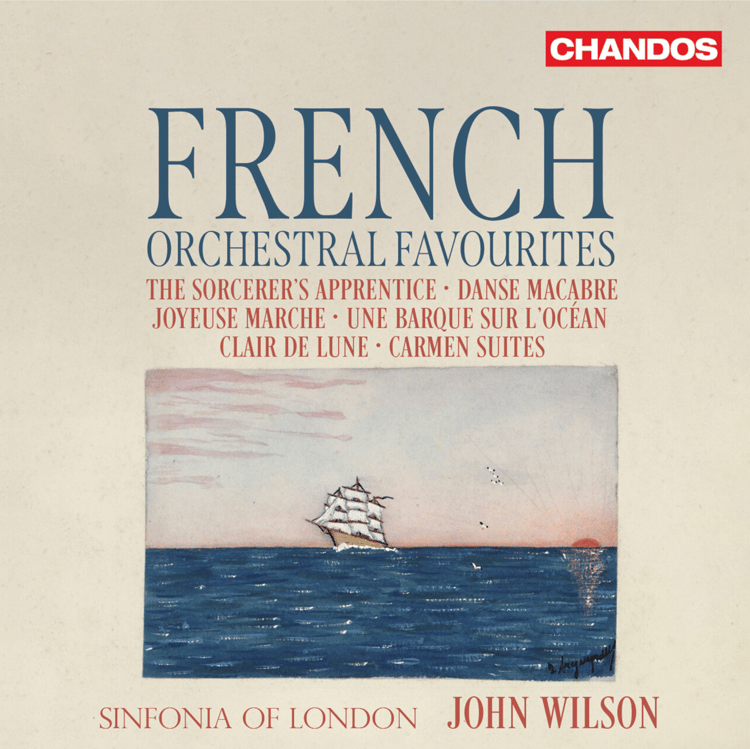
Repertoire-wise, the title tells no lie, because from the strongly narrative theatricality of Dukas’s The Sorcerer’s Apprentice to Bizet’s Carmen Suites Nos 1 and 2 written at the end of the nineteenth century, to the more impressionistic depictions painted in the first years of the 20th by Debussy with Clair de Lune and Ravel with Une Barque sur l’océan, this really is a greatest hits from France’s poetically unGermanic pot of orchestral repertoire – and the Sinfonia of London itself is as technically precise, fizzingly kaleidoscopic and period-informed as ever.
The Sorcerer’s Apprentice gets things off to a bright and finesse-filled start, its narrative tautly timed; and as its tension mounts and the orchestral virtuosity hots up, a further joy is the clarity you’re hearing within Dukas’s blizzard of individual details thanks both to Wilson and to the capturing itself in Kilburn’s Church of St Augustine. Saint-Saëns’s Danse macabre opens with terrific tonal storytelling: first, a bewitchingly heavenly harp ticking along to similarly heavenly, ethereal strings; but then leader John Mills’s devil’s violin breaking acidly in, and onwards into smartly fierily rhythmic, fast-whirling orchestral performance featuring some fantastically string-biting and belly tone from the violin section, and resplendently ringing brass. Une Barque sur l’océan is a fluid beauty, full of wonderful woodwind moments, while further colours include the rippling, portomento’d glide employed by the violins in their stepwise ascents (1’40” is the first instance).
The album is recorded in surround sound, and is available in Dolby Atmos Spatial Audio and as a hybrid SACD. I’ve given you the Ravel and the Saint-Saëns here.