Welcome to the first Classical Choices of 2026! If January’s new releases are a sign of what’s to come, then we’re in for another rich year of recordings. Our highlights this month include an evocative period-instrument cello recital from Steven Isserlis and Connie Shih; a phenomenal pairing of the Enescu and Mendelssohn octets from the Belcea Quartet and Quatuor Ébène; and not one but two magnificent new readings of Elgar’s The Dream of Gerontius, under Edward Gardner and Martyn Brabbins.
We also travel back in time with an archive piece, chosen to commemorate the 200th anniversary of Carl Maria von Weber’s death in 1826: Carlos Kleiber conducting Edith Mathis and the Staatskapelle Dresden in “Kommt ein schlanker Bursch gegangen” from weber’s opera, Der Freischütz, recorded in 1973…
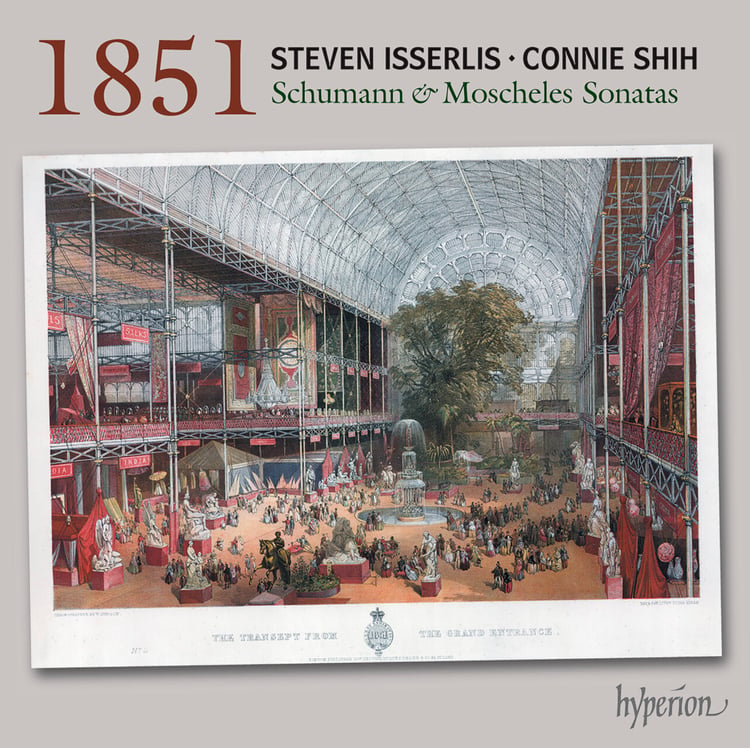
1851: Schumann and Moscheles Sonatas
Steven Isserlis, Connie Shih
Hyperion
“1851 – they don’t make years like that any more”. So remarks Steven Isserlis in his introduction to this recital album, built around a year which indeed presented a wealth of fine material. 1851 was the year when manufacturers from all over the world converged in London to display the works of their modern ingenuity at The Great Exhibition of the Works of Industry – including the French piano firm Érard, whose instruments’ advanced action scooped them a Gold Medal and the admiring attention of large crowds (and Queen Victoria herself).
For this project, Isserlis borrowed an 1851 Érard from the University of Birmingham – perhaps one of the pianos at the exhibition, although we can’t be sure – for his long time duo partner Connie Shih, and recorded works written in that same year by Robert Schumann and Ignaz Moscheles. The two composers are linked by their respective relationships with Felix Mendelssohn. Schumann’s works were championed and conducted by Mendelssohn, and Moscheles was Mendelssohn’s teacher. Both were pallbearers at Mendelssohn’s funeral in 1847.
True to form, Isserlis has dreamed up a historically evocative programme, and brought us something genuinely new: Schumann’s Violin Sonata, transcribed this time for cello. Schumann’s piece sits exceptionally well here on the cello – this is especially the case in the slow movement. On the violin, the melodic line here can feel low to the point of sounding non-idiomatic, but on the cello it sings throughout. Isserlis’s darkly expressive interpretation is rooted in the theory that Schumann conceived his piece as a passionately grieving memorial to Mendelssohn – it being written for their mutual friend and the dedicatee of Mendelssohn’s Violin Concerto, Ferdinand David.
Elsewhere, Isserlis and Shih’s recital of Moscheles’ Cello Sonata in E major (dedicated to Schumann, and coincidentally sharing the same opus number 121 as the Schumann sonata) demonstrates why it was so popular and beloved by Moscheles himself in his time. Generous of proportion, and full of virtuoso piano writing, it dishes up a satisfying blend of drama, optimism and delicacy, with a merry dumka finale that Isserlis and Shih dispatch with fitting folky lightness and dance. Both here and throughout, the combination of Isserlis’s plumply mellow, multicoloured sound and Shih’s nimble partnering on the gracefully responsive Érard is truly stunning.
The album’s shorter pieces give full rein to Isserlis’s formidable lyrical powers: a Romanze by Ferdinand David, originally for the violin; Isserlis’s own transcription of the Schumann lied, Sängers Trost (“The Poet’s Comfort”); then Gesualdo Six joining Isserlis and Shih for a tenderly ravishing recreation of an early performance of Gounod’s “Ave Maria” transcription of JS Bach’s first Well-Tempered Clavier prelude, for which Gounod is reported to have piano-accompanied a violinist while a six-voice choir sang Latin words from an adjoining room. The latter work isn’t quite the outlier that it sounds: Gounod’s passion for Bach was kindled by Mendelssohn, and whilst the piece was published in 1853, there’s every chance that it was composed closer to 1851. In short, it’s an utter delight.
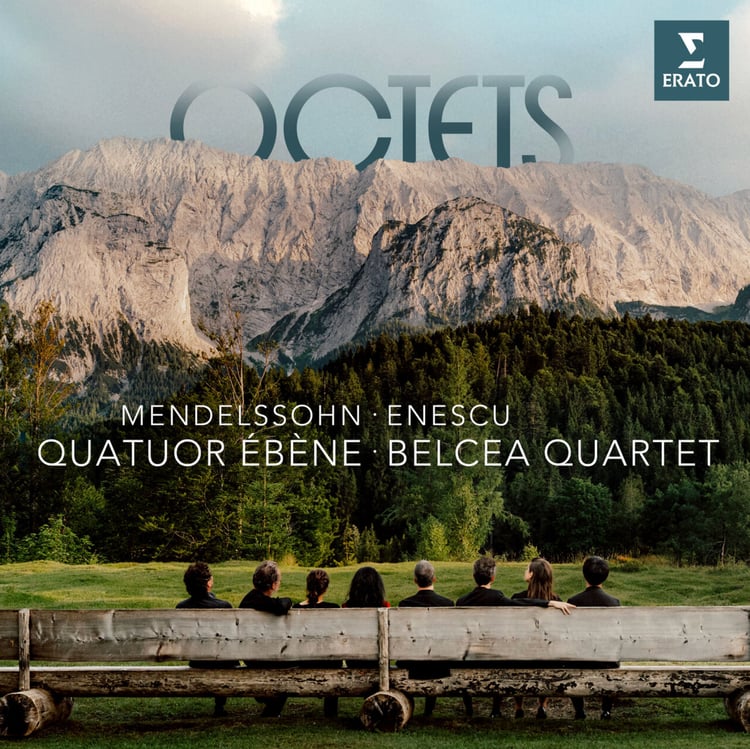
Octets: Mendelssohn and Enescu
Belcea Quartet, Quatuor Ébène
Erato
Artists are often under pressure to offer fresh programming and repertoire with each new release, but sometimes, freshness and brilliance can be contained entirely within the playing. Belcea Quartet and Quatuor Ébène’s new recording of the Medelssohn and Enescu octets is a fantastic example of this. While there’s no shortage of recordings pairing these two famous masterworks (composed when Enescu and Mendelssohn were just teenagers), there are none that sound quite like this new ‘super-league’ offering from two of the world’s greatest string quarters.
The album is Quatuor Ébène’s first recording with Yuya Okamoto, who stepped into founding cellist Raphaël Merlin’s shoes following his departure from the group in 2024. (Merlin remains friends with his Ébène colleagues, and provided the album’s sleeve note.) It also features another relatively new addition to the Belcea Quartet: second violinist Suyeon Kang, who replaced longtime second violinist Axel Schacher in 2022. It’s an album that must have required enormous planning - co-ordinating the diaries of two intensively touring and teaching ensembles is no small feat.
The performances themselves, recorded in Austria’s Schloss Elmau, are zinging with friendship and with joyously daring, living-in-the-moment urgency. Mendelssohn was one of the first composers Quatuor Ébène recorded (in 2013), and Ébène founding first violinist Pierre Colombet leads his Octet with rapturous, power-filled supple freedom and romance, and deliciously exuberant embellishments. Belcea founding first violinist Corinna Belcea leads the Enescu. Like Enescu, Belcea is Romanian-born, and the fast-bowed, portamento’d combination of polished technique and luminous, freewheeling gypsy wildness she’s driving over its four connected movements is edge-of-the-seat stuff, offering staggering superbly polished and conjoined ensemble playing at its most high-speed moments. Listen, for example, to the fast-changing dynamics and superglued rubato elasticity in its Très fougeux and finale. These accounts are electrifying, and I don’t use that word lightly. This will surely win awards.
Elgar: The Dream of Gerontius
Clayton, Platt, Barton, London Philharmonic Orchestra/Gardner on LPO Live
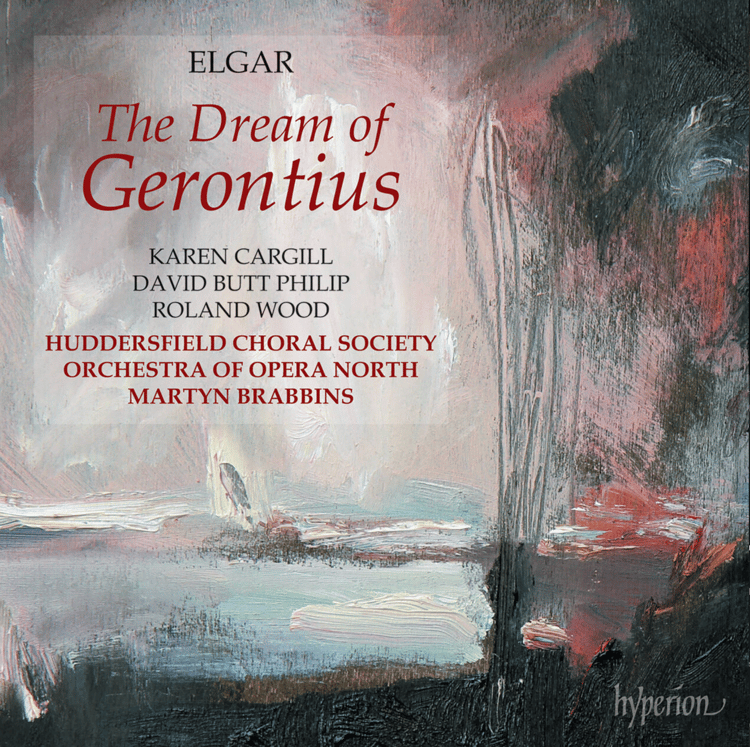
Elgar: The Dream of Gerontius
Butt Philip, Cargill, Wood, Huddersfield Choral Society, Orchestra of Opera North/Brabbins
Hyperion
Elgar’s mighty and mystical The Dream of Gerontius, which sets Cardinal John Henry Newman’s poem depicting a Catholic’s passage from death bed to judgement and Purgatory in the afterlife to music, is having a bit of a moment in the recordings world. In 2024, Paul McCreesh and the Gabrieli Consort and Players released the first-ever period instrument recording of it with a cast headed up by Nicky Spence, which went on to win Gramophone magazine’s 2025 Choral Award. Late last year, the London Philharmonic Orchestra released the live BBC recording of its 2022 BBC Proms performance of the piece under the baton of Edward Gardner, with Allan Clayton singing Gerontius. And this month, Hyperion gives us Martyn Brabbins conducting the Orchestra of Opera North and Huddersfield Choral Society (the choir on the work’s very first recording in 1944), with David Butt Philips in the title role.
These two latest releases are very different. For the LPO reading, the Royal Albert Hall’s cavernous acoustic has necessitated a relatively close capturing, but also a very natural one which remains imbued with the surrounding space’s grandeur. There’s also some satisfyingly vibrant spotlighting of the various strings solos, which are emotively performed. Tempi-wise, this is a Gerontius with its skates on, which makes for excitingly powerful and opera-flavoured momentum, and mostly without sacrificing majesty. The Prelude is particularly effectively judged. Allan Clayton’s bright, focussed tones and theatrical intensity fit perfectly into this aesthetic, and his diction is crystal-clear. Jaime Barton is a warmly serene Angel. The London Philharmonic and Hallé choirs also have a lovely tonal brightness and clarity.
The tempi in Brabbins’s performance, recorded in Huddersfield Town Hall, are within the usual range, but offer no less momentum. The Prelude has all the warmth, width and tingle factor one would hope for. The capturing is slightly wider out here, which shows the violins’ luminously polished, ethereal-sounding moments to the best advantage, and positions the chorus further back in the balance, as if you’re sat in the stalls. It’s a gorgeous choral sound too, ranging from Bach-like warm nobility in the chorales, to English chorister-like delicacy for the assistants’ ‘Kyrie eleison’ and the Choir of Angelicals’ final ‘Praise to the Holiest’. This is a choir that knows how to dish up the drama, snarling its lines as demons. Butt Philip, meanwhile, has a velvety, melancholic elegance which places his Gerontius already halfway to heaven even as he still lies on his deathbed. Against this, Roland Wood’s rich, firm power as the Priest/Angel of Agony provides an invigorating contrast. Karen Cargill as the Angel, meanwhile, strikes a beautiful balance between purity and impassioned humanity.
To have to choose one of these recordings over the other would be a tough call. Better to enjoy both according to your mood.